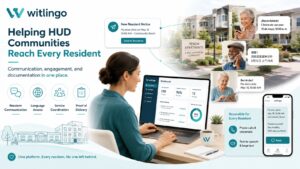
Witlingo is a resident communication and engagement platform designed to help affordable senior housing communities share information, coordinate services, and document outreach—especially in communities supported by U.S. Department of Housing and Urban Development (HUD).
HUD emphasizes communication, access, engagement, and documentation. Witlingo directly supports these goals by providing a centralized system for resident notices, service coordination communication, multilingual access, and engagement tracking.
No. HUD does not mandate specific software tools.
However, HUD does require outcomes that Witlingo helps communities consistently achieve, including:
- Timely resident communication
- Equal access to information
- Documentation of outreach and engagement
- Support for service coordination activities
Witlingo helps communities meet these expectations efficiently.
Many Service Coordinator roles are funded through HUD programs such as ROSS Program and Section 202 Supportive Housing for the Elderly.
Witlingo helps Service Coordinators:
- Share program announcements and reminders
- Distribute resources and forms digitally
- Collect sign-ups and feedback
- Reach residents without relying on paper, phone trees, or in-person follow-ups
- Document communication efforts for reporting and audits
Witlingo creates a digital record of resident outreach, including:
- What was sent
- When it was sent
- How it was delivered
- Which languages were used
This supports HUD reviews related to:
- Resident notification practices
- Service coordination activities
- Program participation documentation
HUD enforces Limited English Proficiency (LEP) requirements.
Witlingo supports LEP compliance by:
- Delivering content in residents’ preferred languages
- Eliminating the need for separate translation workflows
- Ensuring residents receive the same information at the same time, regardless of language
Yes. HUD increasingly emphasizes engagement and quality of life, not just housing.
Witlingo helps by:
- Making programs and activities visible and accessible
- Encouraging participation through reminders and easy sign-ups
- Providing multiple ways for residents to stay connected, including audio and mobile-friendly options
Yes. Witlingo is designed for low digital literacy environments, including:
- Simple mobile access
- Audio-first options
- Minimal resident setup
- No resident accounts required in many use cases
This is especially important in HUD-supported senior communities.
Witlingo is commonly funded through:
- Operating budgets (including Section 202 properties)
- Resident services and engagement line items
- Service coordination budgets supported by HUD programs
No new HUD approval process is required.
No. Witlingo complements existing workflows by:
- Reducing manual communication tasks
- Improving consistency and reach
- Making documentation easier
It integrates naturally into how Service Coordinators already work.
Communities choose Witlingo because it:
- Aligns with HUD’s priorities without adding complexity
- Saves staff time
- Improves resident access to information
- Strengthens documentation and reporting
- Supports equitable communication across languages and abilities
- 50 Resident Communication Problems Service Coordinators Face in Affordable Housing
- Social Isolation in Older Adults: How Communication Helps
- 10 Things a ROSS Coordinator Can Do to Help Residents
- AI and Affordable Housing Resources
- 20 Ways Witlingo Helps Service Coordinators and Property Managers
- Witlingo Rollout Best Practices
Schedule a demo and see how Witlingo helps communities communicate easily and effectively, track delivery, and document outreach.