Resident communication is often treated as a simple operational task: write a message, choose a channel, and send it. In practice, effective communication in affordable housing and senior living communities requires much more.
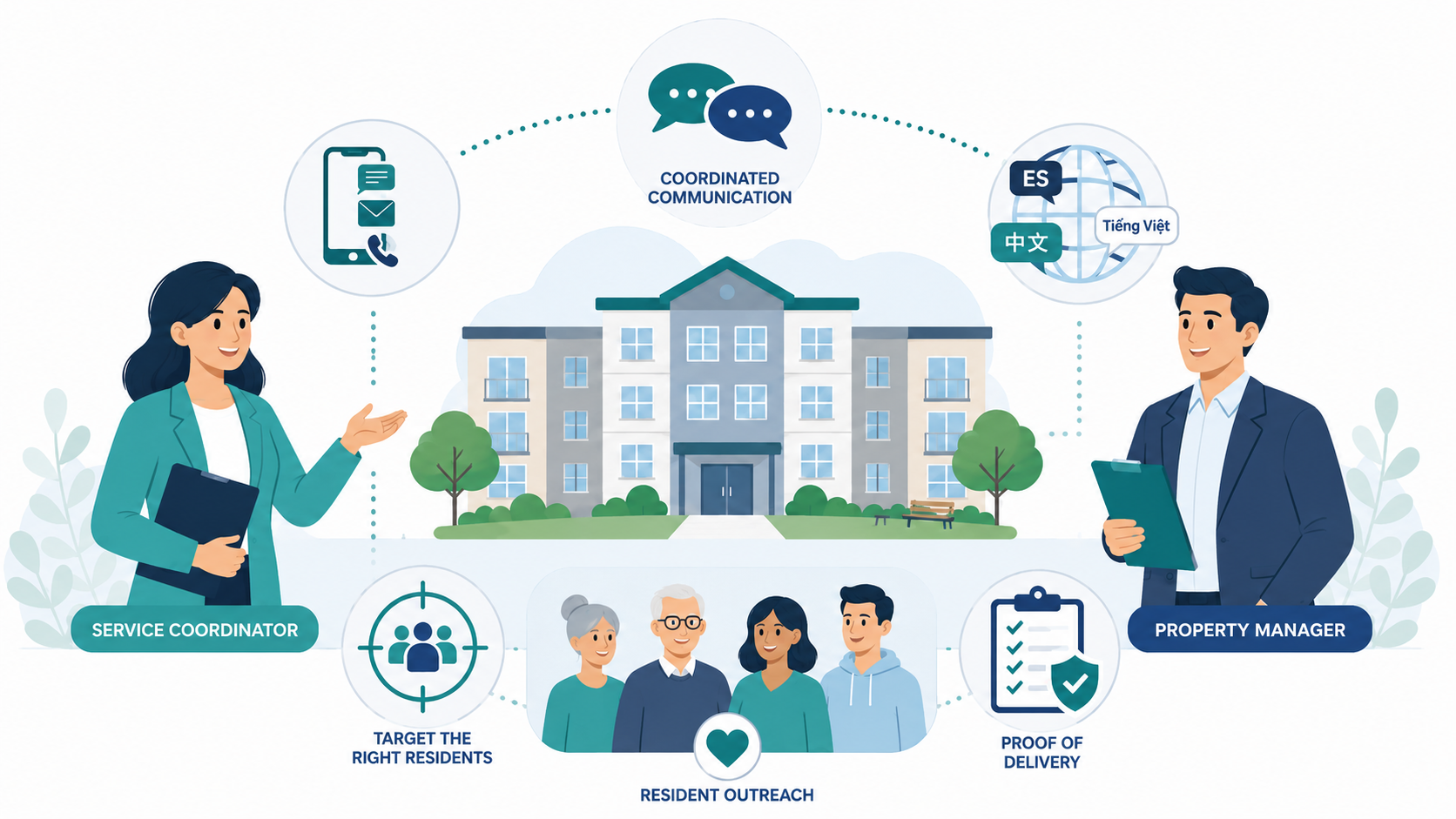
The strongest service coordinators and property managers do not simply communicate more often. They communicate more deliberately. They coordinate across roles, tailor outreach to residents, verify delivery, and follow up when someone still needs help.
These practices improve resident trust, reduce staff effort, and give management greater confidence that important communication is happening consistently.
Service coordinators and property managers have different responsibilities, but residents experience them as part of the same community.
A resident does not necessarily distinguish between a message from resident services and a message from property operations. Conflicting, duplicated, or poorly timed notices can make the entire organization appear disorganized.
Effective teams maintain visibility into what each role is planning and sending. This allows them to coordinate timing, avoid unnecessary duplication, and present a more consistent resident experience.
Shared visibility does not mean that every employee needs unrestricted access to every administrative detail. It means each role has enough information to understand what residents are being told, by whom, and when.
Organizations often choose communication channels based on what is easiest for staff. Effective teams begin with a different question:
Some residents respond to text messages. Others are more likely to answer a phone call, read an email, or listen to a voice notification. A resident’s preferred channel may also change depending on the urgency or complexity of the message.
The objective is not to send a text, place a call, or deliver an email. The objective is to make sure the resident receives information in a form they can use.
This resident-first approach is especially important for older adults, residents with limited digital access, and households in which English is not the preferred language.
Reliable communication begins with reliable data.
The most effective teams regularly review:
- Phone numbers
- Mobile numbers
- Email addresses
- Preferred languages
- Preferred communication channels
- Household contacts
- Building, floor, and unit information
- Program participation and relevant resident groups
When messages repeatedly fail, staff should not simply continue sending to the same outdated phone number or email address. The failure should trigger a review and correction of the resident’s information.
Maintaining accurate resident records is not glamorous, but it is one of the most important communication practices an organization can adopt.
Not every message should go to everyone.
A maintenance notice may affect only one building. A transportation update may apply only to residents enrolled in a particular program. A recertification reminder should go to households approaching a deadline. A wellness event may be most relevant to residents who have expressed interest in similar activities.
Effective teams use information such as building, floor, language, interest, program participation, and status to target the appropriate audience.
This improves relevance and reduces message fatigue. Residents are more likely to pay attention when community messages consistently apply to them.
The goal is not maximum distribution. It is appropriate distribution.
Important deadlines should rarely depend on a single message.
Recertification, inspections, appointments, enrollment periods, document submissions, and community events often require multiple reminders. Effective teams communicate early, remind residents at meaningful intervals, increase urgency as the deadline approaches, and follow up selectively with those who still need attention.
A strong reminder sequence might include:
- An early notice explaining what is coming
- A reminder to prepare required documents
- An appointment reminder
- A final deadline notice
- A follow-up for residents who have not completed the required action
This is more effective than sending the same message repeatedly or waiting until the deadline is imminent.
When every message is described as urgent, residents eventually stop treating anything as urgent.
Effective teams use clear categories and reserve urgent language for genuinely time-sensitive situations. A reminder about next month’s event should not look or sound like a notice about a water shutoff, elevator outage, severe weather event, or building access issue.
This distinction helps preserve resident attention and trust.
It also helps staff coordinate timing. Routine communication can often be delayed or rescheduled when an urgent operational notice must take priority.
The strongest resident messages quickly answer five questions:
- What is happening?
- Who does it affect?
- What does the resident need to do?
- When does the resident need to act?
- Where can the resident get help?
Messages should be concise, specific, and written from the resident’s point of view.
Internal jargon, unexplained acronyms, and long paragraphs create unnecessary barriers. A resident should not need to interpret organizational language to understand whether an inspection is scheduled, an appointment has changed, or a document is required.
Clarity is especially important when messages are translated into multiple languages. Simple source language produces clearer translations and reduces the risk of misunderstanding.
Multilingual communication is not simply a technical translation exercise.
Effective teams begin with clear, plain-language messages and then ensure the translated version preserves the intended meaning. Compliance-related, legal, or high-risk messages may require additional review.
Organizations should also avoid ignoring smaller language groups simply because only a few residents speak that language. Those residents may be the people most likely to miss important information if the organization communicates only in English or in the most commonly requested languages.
Inclusive communication means supporting residents based on need, not only volume.
Timing can determine whether a message is noticed or ignored.
A service coordinator may plan to send a recertification reminder in the morning. At the same time, the property manager may need to send an urgent notice about a water interruption. Without shared visibility, both messages may arrive within minutes of each other, causing the routine reminder to be overlooked.
Effective teams review scheduled communication before sending. They consider urgency, competing notices, time of day, and how frequently residents have already been contacted.
This is where coordination becomes more than an administrative convenience. It directly improves the likelihood that important information is received and acted upon.
Proof of delivery should not be treated as a static report.
Its real value is helping staff identify who still needs attention.
After an important message is sent, effective teams review:
- Which messages were successfully delivered
- Which phone calls were answered
- Which texts or emails failed
- Which residents could not be reached
- Whether another channel should be used
- Whether contact information needs to be corrected
A message marked as sent is not necessarily a message received. A message marked as delivered is not necessarily a message understood.
Proof of delivery provides stronger evidence that communication occurred, but it should also trigger action when the evidence shows that a resident was not reached.
More messages do not automatically produce better outcomes.
Residents may begin to ignore communication when they receive too many notices, especially when those notices are repetitive or irrelevant. Effective teams monitor frequency and make sure every message has a clear purpose, audience, owner, and desired action.
A useful standard is that each message should answer:
- Why is this being sent?
- Why does this resident need it?
- What should happen after the resident receives it?
If those questions cannot be answered clearly, the message may not need to be sent.
Common communication needs should not be rebuilt from scratch every time.
Effective teams create approved templates and repeatable workflows for situations such as:
- Recertification reminders
- Inspection notices
- Maintenance updates
- Event invitations
- Transportation changes
- Weather alerts
- Rent and compliance communication
- Wellness check-ins
- Program enrollment reminders
Reusable workflows improve consistency and reduce staff effort. They also make it easier to train new employees and apply successful practices across multiple communities.
Standardization should not eliminate judgment. Staff should still review and adjust messages based on the situation and the residents affected.
Management visibility should go beyond reviewing one notice at a time.
Leadership should be able to identify broader patterns, including:
- Which communities are communicating consistently
- Whether both service and property teams are participating
- Which channels are being used
- Which languages are being supported
- Which message types have low delivery rates
- Where contact data repeatedly fails
- Whether some residents are being over-messaged
- Whether important communication is missing
This information should be used to improve operations and support staff, not simply to count how many messages each person sends.
High message volume is not automatically a sign of strong performance. The real indicators are relevance, timeliness, reach, consistency, and successful follow-through.
Technology should reduce repetitive work, not replace personal support.
When routine reminders and updates can be communicated efficiently, service coordinators and property managers have more time to focus on residents who need personal assistance, additional explanation, or help completing an important task.
A resident who does not respond to several reminders may not need another automated message. They may need a phone call, an office visit, or help understanding what is required.
The most effective organizations use technology to identify where human attention is needed most.
The most effective service coordinators and property managers follow four principles:
- They coordinate across staff: They understand that residents experience the organization as one community.
- They match communication to the resident: They use the appropriate language, channel, timing, and level of urgency.
- They verify what happened after sending: They do not assume that pressing Send means the resident was reached.
- They follow up personally when needed: They use technology to identify exceptions, then apply human judgment and support.
A communication platform can make these practices easier to apply, repeat, and measure. But the value does not come from the technology alone. It comes from using the technology to create a more coordinated, inclusive, accountable, and resident-centered way of operating.