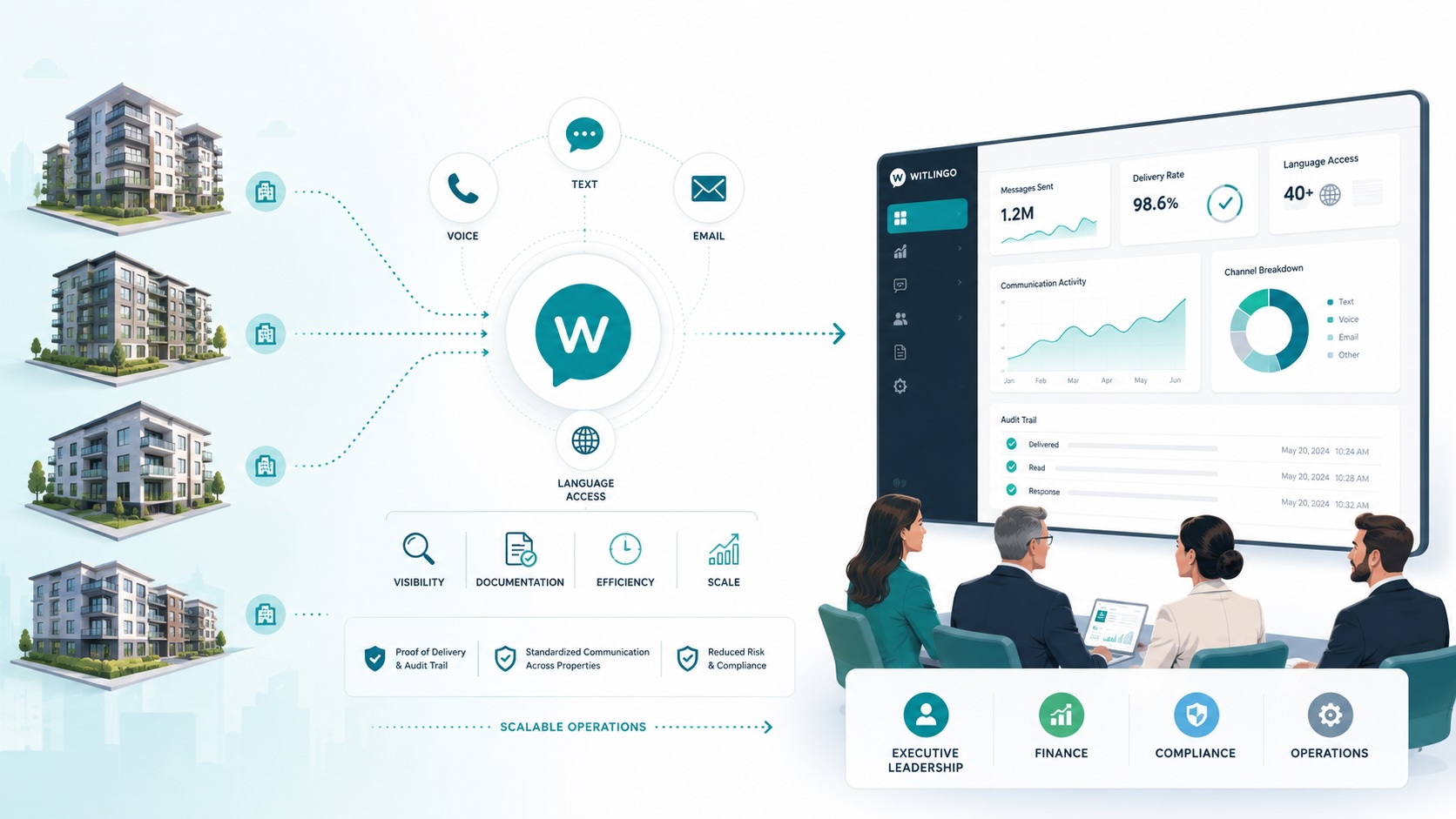
Witlingo gives business leaders greater visibility into resident communication, stronger documentation, lower administrative burden, and more consistent execution across properties.
These use cases focus on the outcomes that matter most to executives, CFOs, compliance leaders, operations teams, housing authority leadership, and portfolio managers.
Executives can see how frequently properties are communicating with residents, which channels are being used, and what types of information are being distributed.
This replaces fragmented reporting and gives leadership a clearer picture of communication activity across the organization.
Leadership can quickly identify communities that may not be communicating consistently with residents.
This creates an opportunity to intervene before communication gaps lead to complaints, missed deadlines, low participation, or compliance concerns.
Executives can compare notification volume, delivery rates, resident responses, language usage, and channel adoption across multiple communities.
This helps leadership identify strong performers, inconsistent practices, and opportunities for operational improvement.
Organizations can establish approved templates and communication practices while still allowing local teams to adapt messages for individual communities.
This supports consistency across the portfolio without creating an overly centralized process.
Executives can use communication reports to show boards, funders, regulators, partners, and other stakeholders that the organization is making consistent efforts to keep residents informed.
Instead of relying on anecdotal evidence, leadership can point to documented communication activity.
Witlingo reduces the time staff spend making phone calls, printing notices, preparing mailings, answering repeated questions, and manually following up with residents.
This allows organizations to handle more communication without adding administrative staff.
By delivering notices through digital and voice channels, organizations can reduce their dependence on printed flyers, mailed reminders, and door-to-door distribution.
Printed communication can still be used when necessary, but it no longer needs to be the default for every message.
Property managers and service coordinators can automate recurring reminders and distribute one message across multiple channels.
This allows staff to spend more time on resident support, compliance work, property operations, and other higher-value responsibilities.
When important deadlines, payment reminders, inspections, or document requests are not communicated effectively, the organization may face avoidable financial and operational consequences.
Witlingo helps reduce this exposure by creating consistent communication workflows and delivery records.
Financial leaders can determine whether properties are actively using the communication tools the organization is paying for.
Usage data helps leadership identify underused locations and improve the return on the organization’s technology investment.
Compliance teams can review what was sent, when it was sent, which residents were included, and which communication channels were used.
This provides stronger documentation than disconnected spreadsheets, paper files, or individual staff email accounts.
Organizations can maintain a record of recertification reminders, document requests, appointment notices, missed-deadline follow-ups, and escalation messages.
This helps demonstrate that staff made consistent efforts to keep residents informed and move the process forward.
Compliance teams can distinguish between a message being created, sent, delivered, and successfully received through a particular channel.
This provides a more accurate view of resident outreach than simply confirming that a staff member pressed “send.”
Witlingo can help organizations document that residents received important communications in their preferred languages.
This supports more equitable communication while giving compliance leaders greater visibility into language-access practices.
When a resident says that a notice was never received, staff can review the communication history for that resident.
This allows the organization to respond with facts rather than relying on memory, paper records, or conflicting accounts.
Regional and portfolio leaders can see upcoming and past-due deadlines across communities without requesting separate reports from each property.
This supports earlier intervention and reduces dependence on manually maintained spreadsheets.
When communication processes depend on the habits and memory of individual employees, staff departures can create serious operational gaps.
Witlingo preserves templates, schedules, communication histories, and workflows so that important processes can continue when roles change.
Leadership can establish repeatable processes for recertifications, inspections, emergencies, lease renewals, and other recurring communication needs.
This reduces variation between properties and makes performance less dependent on the communication style of each manager.
High failure rates, outdated contact information, low resident response, or limited communication activity can signal operational problems.
Portfolio leaders can identify these patterns early and address them before they contribute to missed deadlines, resident frustration, or compliance risk.
As an organization adds properties or residents, communication volume can grow rapidly.
Witlingo allows organizations to scale resident communication through automation, templates, centralized visibility, and multi-channel delivery without increasing administrative work at the same rate.
For business buyers, Witlingo is not simply a tool for sending messages. It is infrastructure for managing communication across an organization.
It helps leadership:
- Reduce administrative costs
- Improve portfolio-wide visibility
- Strengthen compliance documentation
- Standardize critical communication processes
- Reduce operational and financial risk
- Improve resident access to information
- Measure whether important messages are reaching residents
- Scale communication across more properties
- Improve accountability at every level of the organization
The result is a more consistent, measurable, and defensible approach to resident communication.
Schedule a demo and see how Witlingo helps communities communicate easily and effectively, track delivery, and document outreach.