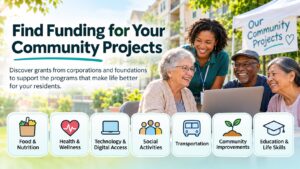
You have an idea that could make life better for your residents. Maybe it's a new food pantry, a community event, transportation assistance, technology, or supplies for a resident program.
The cost might be just $1,000, $3,000, or $10,000.
But your community doesn't have the budget, and finding organizations willing to fund smaller projects can be frustrating and time-consuming.
We're here to help you find funding opportunities for the projects that matter to your residents.
Explore corporations, foundations, and community grant programs that support local initiatives, including projects that require just a few thousand dollars.
Many companies and foundations support small community-based initiatives. Depending on the funding program, eligible projects may include:
You don't necessarily need a large initiative or an elaborate proposal. Some funders specifically support modest, local projects with clear community benefits.
We've identified corporate and foundation giving programs that may help fund small community projects.
Grant availability, award amounts, geographic restrictions, and applicant eligibility vary.
Typical funding: $250–$5,000
Walmart offers local grants to eligible organizations working to improve their communities.
Good for: Food assistance, community activities, resident programs, and local initiatives.
Funding: Up to $15,000 through the 2026 flagship grant program.
Supports projects that make communities more livable, particularly for older adults.
Good for: Social engagement, accessibility improvements, technology access, and community participation.
Funding: Varies by program.
Supports eligible nonprofit organizations working to strengthen communities through stable housing, economic opportunity, and other community initiatives.
Good for: Resident assistance programs, community services, and initiatives that help people overcome barriers.
Funding: Varies by program and location.
Supports nonprofit initiatives addressing economic mobility, affordable housing, and essential community needs.
Good for: Projects helping low-income residents access services and opportunities.
Funding: Community grants in the $5,000–$10,000 range.
Supports eligible nonprofit organizations addressing community needs, including health and human services.
Good for: Community enrichment, essential services, and resident support initiatives.
Funding: Small grants up to $10,000.
Supports programs addressing important community challenges, primarily in Baltimore.
Good for: Innovative community initiatives, access to services, and neighborhood improvements.
Funding: Certain grant programs offer $5,000–$10,000.
Supports qualifying nonprofits within its geographic service area.
Good for: Community enrichment, human services, education, and related initiatives.
Funding: Small gift card donations and selected community grants.
Supports local organizations through various giving programs.
Good for: Supplies, community activities, educational events, and basic needs.
Start with a specific problem you want to solve.
For example:
The more specific the project, the easier it may be to find a suitable funding opportunity.
Look for funders that support your type of project, operate in your geographic area, and offer grants close to the amount you need.
Review the eligibility requirements carefully.
Most grant applications ask for some combination of:
You can often prepare the core information in a one- or two-page proposal and adapt it for different applications.
Submit your application through the funder's official website, track deadlines, and retain copies of your proposal and budget.
If your request is approved, keep records of how the funds are used and the outcomes achieved.
Project Description:
Our community seeks funding to provide a series of health and wellness activities for older adults, many of whom face financial barriers and limited transportation options.
Funding will support monthly wellness workshops, educational materials, basic supplies, and resident participation activities.
Proposed Budget
| Expense | Amount |
|---|---|
| Workshop instructors | $1,200 |
| Program supplies | $600 |
| Educational materials | $300 |
| Refreshments | $400 |
| Outreach and communications | $300 |
| Miscellaneous expenses | $200 |
| Total | $3,000 |
Expected Results:
- At least 40 residents participating in one or more activities.
- Six wellness workshops delivered.
- Increased awareness of available health and wellness resources.
- Resident feedback collected to evaluate the program.
A sample for illustration. Each proposal should reflect the community's actual needs and the funder's rules.
Can I apply for funding as an individual Service Coordinator? Some funding programs accept individual or community-led applications, but many require a registered nonprofit, housing authority, school, or other eligible organization. Check the program's requirements before applying.
Does my project need to benefit older adults? No. Many grant programs support residents of all ages, including families, people with disabilities, and low-income households.
Can I request just $1,000 or $2,000? Yes. Some corporate giving programs specialize in small local contributions, while others establish higher minimum or maximum grant amounts.
Can grant funding pay for technology or software? Some programs allow technology, equipment, subscriptions, and outreach expenses when they support an eligible community project. Always check the funder's guidelines.
What if my property is managed by a for-profit company? You may need to partner with an eligible nonprofit organization or government entity to submit an application. Not every funder accepts applications through fiscal sponsors.
Can I apply to multiple programs? Generally, yes, provided you comply with each funder's requirements and disclose other sources of funding when requested. The same expense should not be charged twice to different funders.
Are these grants guaranteed? No. Applications are reviewed independently by each funding organization, and available funding is often competitive.
At Witlingo, we work with Service Coordinators, property managers, and community organizations that are committed to helping residents stay informed, connected, and supported.
We created this resource because we know that even modest funding can make a meaningful difference in a community.
Our goal is simple: Help good community projects find the support they need.
Disclaimer: Witlingo is not affiliated with the grantmaking organizations listed above and does not award or guarantee funding. Programs, eligibility requirements, grant amounts, and deadlines may change. Check each organization's official website before applying.