Fraud targeting older adults often appears first as isolated incidents. A resident tells a service coordinator about a suspicious Medicare call. A property manager hears about a gift card scam. Another community reports residents receiving similar text messages. Individually, these incidents may seem unrelated. Across multiple communities, however, they can reveal an emerging pattern.
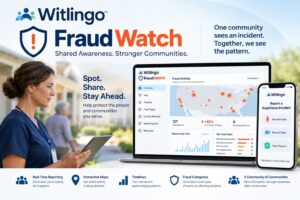
Witlingo Fraud Watch is a senior fraud prevention network designed to help senior living and affordable housing communities share reports of suspicious activity, identify emerging scams, and understand how fraud targeting older adults may be spreading across communities.
Senior living staff hear about suspicious activity every day. Residents may report calls claiming to be from Medicare or Social Security, requests for gift cards or money, suspicious emails or text messages, fake utility notices, door-to-door solicitations, requests for personal or financial information, and new scam tactics.
The problem is that these reports usually stay inside individual communities. A service coordinator may have no way of knowing that staff at several nearby communities are hearing about the exact same scam. Important warning signs remain disconnected, and opportunities to alert other communities may be missed.
Fraud Watch gives service coordinators, property managers, management teams, and other staff across the Witlingo network a way to share suspicious activity as it happens. Reports from participating communities are brought together in real time, creating a continuously updated picture of what communities are seeing.
One report may be an isolated incident. Ten similar reports across several communities may reveal something much more important. One community may see an incident, while the network can see the pattern.
Fraud Watch is designed to make large amounts of information easy to understand. Instead of presenting staff with a long list of individual reports, Fraud Watch organizes activity into visual views that make patterns easier to detect.
Reported fraud activity can be viewed geographically so users can see where incidents are occurring and whether a particular scam appears to be concentrated in a city, region, or group of communities. A geographic view can quickly turn scattered reports into an understandable pattern.
Reports can also be viewed on a timeline so users can see when a scam first appeared, whether reports are increasing, and whether activity is spreading or declining. A handful of reports over several months may mean one thing, while a dozen similar reports appearing within three days may indicate something much more significant.
Fraud Watch organizes activity by categories such as Medicare scams, Social Security scams, government impersonation, gift card scams, technology support scams, utility scams, identity theft attempts, and other emerging fraud tactics. This makes it easier to understand what kinds of threats residents are encountering.
Users can also see the methods scammers are using, including phone, text, email, mail, and in-person contact. Patterns that are difficult to recognize in individual reports become much easier to see when the information is viewed together.
Imagine a service coordinator reports that two residents received suspicious calls from someone claiming to represent Medicare. Later that day, another community reports the same thing. The following morning, several additional communities report similar calls.
Fraud Watch brings those observations together as they are reported. Staff across the network can see that the issue is no longer one isolated incident but an emerging pattern. That gives communities an opportunity to warn residents before the same scam reaches them.
Not every service coordinator or property manager needs to actively contribute for Fraud Watch to be valuable. A staff member who has never submitted a report can still see new fraud activity appearing nearby, scams being reported by other communities, changes in activity over time, geographic concentrations, emerging fraud categories, and common methods being used to target residents.
This means reports contributed by a relatively small number of communities can benefit many others. A few people may contribute the observations, but the entire network can benefit from the resulting visibility.
Witlingo helps communities share information. Because many communities are connected through the Witlingo platform, they can also learn from one another.
Fraud Watch takes information that might otherwise remain inside one property and makes the broader pattern visible across the network. As more communities participate, the picture becomes richer and more useful, helping staff recognize emerging threats earlier.
- Service Coordinators: Service coordinators can learn what peers in other communities are hearing from residents and identify scams that may soon reach their own community.
- Property Managers: Property managers can gain visibility into fraud-related activity affecting residents and better understand whether incidents are isolated or part of a broader trend.
- Management: Management teams can see activity across communities, properties, and regions without having to manually collect and combine information from individual sites.
What is senior fraud prevention?
Senior fraud prevention includes efforts to help older adults, caregivers, housing staff, and communities recognize, communicate, and respond to potential scams and financial exploitation.
What scams commonly target older adults?
Common examples include Medicare and Social Security impersonation, gift card scams, technology support scams, utility scams, identity theft attempts, phishing messages, and fraudulent requests for personal or financial information.
How can senior living communities help prevent fraud?
Communities can educate residents, share warnings, encourage residents to report suspicious activity, and help staff identify patterns that may indicate a scam is affecting multiple residents or communities.
What is an elder fraud prevention network?
An elder fraud prevention network allows people and organizations serving older adults to share information and coordinate efforts to identify and respond to fraud and financial exploitation.
What is Witlingo Fraud Watch?
Witlingo Fraud Watch helps participating communities report suspicious activity and see fraud reports across locations, time periods, fraud categories, and communication methods so emerging patterns can be recognized earlier.
Fraud Watch does not determine conclusively that fraud has occurred and does not replace law enforcement or official reporting authorities. Its purpose is to help communities share what they are seeing so that emerging fraud patterns can be recognized earlier and communicated more broadly.
Every community sees only a small part of what is happening. Together, communities can see much more. Fraud Watch helps make that shared visibility possible.
Schedule a demo and see how Witlingo helps communities communicate easily and effectively, track delivery, and document outreach.