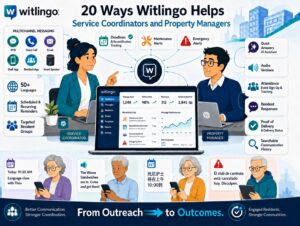
Service coordinators and property managers are responsible for keeping residents informed, managing deadlines, coordinating services, promoting programs, and documenting outreach.
Witlingo helps reduce that workload by making resident communication faster, more consistent, more accessible, and easier to track.
1. Send one message across multiple channels
Staff can create one notification and deliver it through text messages, automated phone calls, email, the staff and resident mobile apps, and supported smart speakers.
This eliminates the need to recreate the same message for each communication channel.
2. Communicate with residents in more than 50 languages
Witlingo can automatically deliver messages in each resident’s preferred language.
Service coordinators and property managers can communicate with multilingual communities without manually translating every notice or relying on residents’ family members.
3. Schedule messages in advance
Staff can create a message when they have time and schedule it for delivery later.
This is useful for inspections, meetings, community events, office closures, document deadlines, and other planned communications.
4. Automate recurring reminders
Weekly activities, transportation schedules, health programs, rent reminders, and other repeating communications can be scheduled once and delivered automatically.
This reduces repetitive administrative work and ensures that reminders are sent consistently.
5. Manage resident deadlines
Staff can track recertifications, lease renewals, document submissions, inspections, appointments, and other important deadlines.
Deadlines can be viewed by time period, including those approaching within the next 7, 14, 30, 60, or 90 days.
6. Automate recertification communication
Property teams can create a sequence of reminders before and after each resident’s recertification deadline.
Messages can remind residents to schedule appointments, gather documents, submit missing information, and respond to past-due requests.
7. Send targeted messages to specific residents
Staff can send communications to selected residents rather than the entire community.
Messages can be targeted by building, floor, language, program, tag, deadline status, or another defined group.
8. Notify residents about maintenance and service interruptions
Property managers can quickly communicate about water shutoffs, elevator outages, heating problems, pest-control visits, construction, and other maintenance issues.
Messages can be limited to the residents who are directly affected.
9. Send emergency alerts quickly
During severe weather, safety incidents, utility failures, or other emergencies, staff can distribute urgent information through multiple channels at once.
Using several channels increases the likelihood that residents receive time-sensitive instructions.
10. Reduce repetitive phone calls
Residents often call the office to ask the same questions about activities, transportation, deadlines, appointments, and community services.
Proactive notifications, accessible calendars, mobile content, and AI-powered answers can reduce these routine calls.
11. Give residents access to quick answers
The Witlingo AI Assistant can answer questions using approved calendars, newsletters, schedules, and community documents.
Residents can find routine information without waiting for a staff member to answer the phone.
12. Create audio versions of written content
Staff can turn newsletters, notices, flyers, and other documents into audio.
This makes information more accessible to residents with limited vision, reading difficulties, or a preference for listening.
13. Track event registrations
Service coordinators can see which residents have signed up for meals, classes, transportation, health programs, and community events.
This helps staff plan seating, supplies, food, transportation, and staffing.
14. Record actual attendance
Staff can track who attended an event rather than relying only on registration numbers.
This provides a more accurate picture of resident participation and program performance.
15. Identify residents who may need additional outreach
Attendance and engagement patterns can help staff notice when a resident stops participating in programs or responding to communications.
This can prompt timely outreach to residents who may be isolated or need additional support.
16. Receive and understand resident responses
Residents can respond to messages by text or through the mobile app.
Responses written in another language can be displayed alongside an English translation, helping staff manage multilingual two-way communication.
17. Track whether messages were delivered
Staff can review the delivery status of text messages, phone calls, emails, and app notifications.
This helps them distinguish between a message that was sent successfully and one that failed because of outdated contact information or another issue.
18. Maintain a searchable communication history
Property managers and service coordinators can review what was sent, when it was sent, who received it, and who created the message.
This reduces reliance on personal email accounts, paper records, memory, and disconnected spreadsheets.
19. Improve coordination between staff members
Property managers and service coordinators can see communication activity across their community.
This helps prevent duplicate messages, conflicting information, and situations in which one staff member is unaware of what another has already communicated.
20. Demonstrate resident outreach
Witlingo provides documentation showing the messages, reminders, and follow-up attempts made by staff.
This gives service coordinators and property managers stronger support when responding to supervisors, residents, families, compliance teams, or auditors.
Schedule a demo and see how Witlingo helps communities communicate easily and effectively, track delivery, and document outreach.