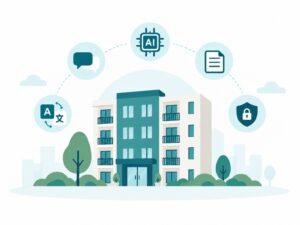
AI in affordable housing is increasingly being used to improve resident communication, translation, property management workflows, staff productivity, and access to information. Used responsibly, artificial intelligence can help affordable housing organizations reduce repetitive work while giving staff more time to focus on residents.
But AI in affordable housing is not simply about chatbots or automation.
Used well, AI can help property managers, service coordinators, compliance teams, and portfolio leaders spend less time on repetitive administrative work and more time on the people and issues that require human judgment.
This guide explains what AI means for affordable housing, why it matters, where it can provide value, and where organizations should be cautious.
AI in affordable housing refers to the use of artificial intelligence to help staff perform tasks such as creating communications, translating messages, answering routine questions, summarizing information, identifying patterns, organizing resident responses, and supporting administrative workflows.
In many cases, AI works best as an assistant rather than as a replacement for existing systems or staff.
A property management system may continue to handle accounting, rent, maintenance, compliance, recertifications, and other core workflows, while AI-powered tools help staff communicate more effectively, process information faster, and reduce repetitive work.
Affordable housing organizations often operate with limited staff while managing increasingly complex responsibilities.
Property managers and service coordinators may be responsible for hundreds of residents, multiple communication channels, deadlines, inspections, events, documentation requirements, language barriers, and recurring questions.
Across a larger portfolio, those challenges multiply.
AI can help reduce some of that burden by making everyday tasks faster, more consistent, and easier to manage.
The goal is not to remove the human element from affordable housing.
The goal is to give staff better tools.
Some of the most practical applications of AI in affordable housing include:
- Resident communication
- Multilingual translation
- Recertification reminders
- Resident response management
- Leasing and applicant questions
- Maintenance intake
- Document summarization
- Staff productivity
- Portfolio analytics
- Accessibility
These applications do not require organizations to redesign their entire technology infrastructure.
In many cases, AI can be introduced gradually into existing workflows.
One of the most immediate uses of AI in affordable housing is resident communication.
The challenge is not simply sending a message.
The challenge is reaching residents consistently across the channels they actually use.
- One resident may prefer text.
- Another may respond to a phone call.
- Another may rely on email or a mobile app.
- Another may need information in a different language.
AI can make content easier to create, translate, summarize, and adapt, while communication platforms can distribute that content across multiple channels.
Instead of forcing every resident into a single communication method, affordable housing organizations can use technology to meet residents where they are.
Affordable housing communities often serve residents who speak multiple languages.
That can make routine communication difficult for staff.
AI-powered translation can help organizations create notices in residents' preferred languages and translate inbound resident responses for staff.
Examples include:
- Recertification notices
- Inspection reminders
- Maintenance announcements
- Rent reminders
- Community events
- Emergency communications
- Policy updates
- Resident questions
Language should not become a barrier between staff and residents.
AI can help reduce that barrier while still allowing staff to review important communications.
Affordable housing organizations already rely on platforms such as Yardi, MRI, RealPage, ResMan, and other property management systems.
AI does not necessarily replace those platforms.
Instead, it can complement them.
A property management system may handle:
- Accounting
- Rent
- Compliance
- Work orders
- Recertifications
- Resident records
- Leasing
- Reporting
An AI-enabled communication platform may focus on a different question:
How do we actually reach residents, explain what they need to do, remind them at the right time, and understand their responses?
These systems can play different but complementary roles.
Affordable housing is a people-centered business.
Residents may be dealing with financial stress, disabilities, language barriers, family issues, or complex compliance requirements.
Many situations require empathy, context, discretion, and human judgment.
AI is most useful when it handles repetitive tasks and gives staff more capacity to focus on those situations.
A useful principle is:
Automate the repetitive work. Keep people responsible for important decisions.
- AI can draft a reminder.
- A person should decide whether that reminder is appropriate.
- AI can summarize a resident message.
- A person should decide how to respond.
- AI can identify patterns.
- A person should decide what those patterns mean.
AI can provide significant benefits, but affordable housing organizations should understand its limitations.
AI should not make unchecked decisions that affect access to housing, eligibility, resident treatment, or other protected areas.
Organizations should understand how an AI system is being used and where human review is required.
AI systems can sometimes generate incorrect or misleading information.
Important notices, compliance communications, policy explanations, and resident-specific instructions should be reviewed before they are distributed.
Affordable housing organizations handle sensitive resident information.
AI systems should be evaluated carefully for security, privacy, access controls, and data retention practices.
Staff should understand when AI is being used and what role it plays.
Residents should not be misled into believing an automated system is a person when that distinction matters.
The more important the decision, the more important human oversight becomes.
AI should support decision-making rather than silently replace it.
AI will likely become a normal part of affordable housing operations.
But the most valuable applications may not be the most dramatic ones.
The biggest improvements may come from everyday tasks:
- Writing a resident reminder in seconds instead of several minutes.
- Automatically translating a message.
- Helping staff understand a resident response.
- Turning a long notice into a short explanation.
- Making information available through audio.
- Identifying residents who may not be receiving communications.
- Reducing the repetitive work required to manage a growing portfolio.
The organizations that benefit most from AI will not necessarily be the ones that automate the most.
They will be the ones that use AI deliberately, keep people in control, and apply it to real operational problems.
Witlingo focuses on one of the most persistent challenges in affordable housing: reaching and engaging residents.
Witlingo helps affordable housing staff communicate through text, phone, email, mobile apps, smart speakers, NFC, QR codes, and other digital experiences.
AI can help make those communications easier to create, translate, summarize, and manage.
The objective is simple: Give staff better tools to reach more residents without creating more administrative work.