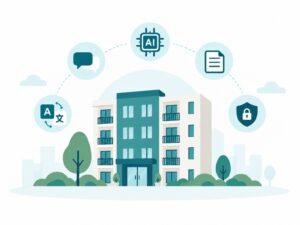
Artificial intelligence can help affordable housing property managers reduce repetitive work, communicate more effectively with residents, manage deadlines, and gain better visibility across their communities.
The most useful applications of AI are often practical rather than futuristic.
They involve tasks property managers already perform every day: writing reminders, translating messages, following up with residents, summarizing information, responding to questions, and tracking activity.
Here are some of the most practical ways affordable housing organizations can use AI today.
Property managers regularly send notices about inspections, rent, maintenance, recertifications, community events, weather emergencies, and other issues.
AI can help draft those communications quickly.
- A property manager might enter: “Remind residents that annual inspections begin Monday and they must provide access to their unit.”
- AI can turn that instruction into a clear resident-facing notice.
- Staff can then review, edit, and approve it before sending.
Affordable housing communities frequently include residents who speak different languages.
AI can help translate notices into each resident's preferred language.
This can be especially useful for:
- Inspections
- Recertifications
- Maintenance notices
- Rent reminders
- Community events
- Emergency alerts
- Building announcements
AI can also translate resident responses back into English for staff.
This allows property teams to communicate more consistently without manually translating every interaction.
Recertifications require repeated communication over weeks or months.
AI can help create a structured series of reminders such as:
- Your recertification is coming soon
- Please schedule your appointment
- Documents are still needed
- Your deadline is next week
- Final reminder
- Your deadline is today
- Your recertification is past due
Instead of creating each message manually, staff can use AI to generate consistent communications throughout the process.
Residents may reply by text, email, or mobile app.
Those responses can arrive in different languages and formats.
AI can help:
- Translate responses
- Summarize long messages
- Identify questions
- Highlight urgent issues
- Organize responses for staff review
The property manager still determines what action should be taken.
AI simply makes the information easier to process.
Property management teams often answer the same questions repeatedly.
Examples include:
- When is the office open?
- When is my inspection?
- What documents do I need?
- How do I submit a maintenance request?
- When is rent due?
- Where is the community event?
- How do I contact my service coordinator?
AI can help organizations provide quick answers to routine questions while allowing staff to focus on situations that require personal attention.
Maintenance requests often arrive as unstructured messages.
A resident might say:
“My bathroom ceiling is leaking again and the floor is getting wet.”
AI can help identify:
- The type of problem
- The location
- The urgency
- Whether additional information may be needed
That information can then be routed into the appropriate workflow.
AI should support maintenance staff rather than make safety-critical decisions on its own.
Property managers frequently work with long documents.
AI can help turn those documents into:
- Short summaries
- Resident-friendly explanations
- Frequently asked questions
- Audio summaries
- Multilingual versions
- Staff briefing notes
This can make complex information easier to distribute and understand.
AI can help property staff draft routine content such as:
- Resident notices
- Emails
- Follow-up messages
- Meeting summaries
- Event announcements
- Internal updates
- Frequently asked questions
- Reports
This reduces the amount of time spent starting from a blank page.
AI can also help organizations identify communication patterns across multiple properties.
Management teams may want to know:
- Which properties are communicating most frequently
- Which languages are being used
- Which messages receive the most responses
- Which residents may not be reachable
- Which communities have unusually high activity
- Which reminders appear to produce action
This type of visibility can help regional and executive teams identify where additional support may be needed.
AI can help transform the same content into different formats.
A written notice might become:
- A shorter version
- A simpler-language version
- A translated version
- An audio version
- A mobile-friendly message
This gives affordable housing organizations more ways to reach residents with different needs and preferences.
Imagine a property manager responsible for a 200-unit affordable housing community.
- Thirty residents have recertification deadlines approaching.
- Some prefer English.
- Others prefer Spanish, Mandarin, Arabic, or Vietnamese.
- Some residents respond quickly to text.
- Others are easier to reach by phone.
Without automation, staff may spend hours writing messages, making repeated calls, translating information, and tracking follow-up.
An AI-enabled resident communication platform can help the property manager:
- Create a clear recertification reminder.
- Translate it into each resident's preferred language.
- Deliver it across multiple communication channels.
- Track whether the communication was delivered.
- Collect resident responses.
- Translate responses for staff.
- Send follow-up reminders as deadlines approach.
The property manager remains in control.
AI reduces the repetitive work surrounding the process.
Platforms such as Yardi, MRI, RealPage, and ResMan handle core property management workflows.
AI can complement those systems by helping staff communicate with residents around those workflows.
For example, a property management system might indicate that a recertification is approaching.
An AI-enabled communication platform can help staff explain the deadline, translate the message, send reminders, and collect resident responses.
One system manages the workflow.
The other helps staff reach the resident.
Witlingo helps property managers and service coordinators reach residents through multiple channels from one platform.
These channels can include:
- Text
- Phone
- Mobile apps
- Smart speakers
- NFC
- QR codes
AI can help staff create communications, translate messages, process resident responses, summarize information, and reduce repetitive administrative work.
For organizations managing multiple communities, Witlingo can also provide management visibility into communication activity across properties.
The goal is not to replace property managers.
The goal is to give them more capacity.
Affordable housing organizations do not need to automate everything at once.
Start with a repetitive task that already consumes staff time.
Good candidates include:
Resident notices
- Translation
- A chatbot that is fed the calendar and newsletter and that can answer questions from residents
- Recertification reminders
- Frequently asked questions
- Document summarization
- Resident response management
Then evaluate whether AI improves:
- Staff time
- Resident response
- Communication consistency
- Language access
- Documentation
- Resident experience
Once a use case proves useful, expand gradually.
Witlingo helps affordable housing property managers reach and engage residents across multiple communication channels while reducing repetitive administrative work.
See how Witlingo can help your property management team communicate more effectively with residents.