
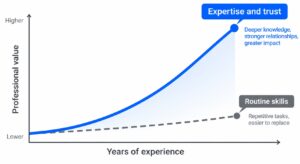
Your greatest professional value isn't in how much work you do. It's in the knowledge, judgment, and relationships that only you can bring to the job.
As a service coordinator, you have something that takes years to build: a deep understanding of your residents, the complicated systems they depend on, and the people and organizations that can help them.
Yet how much of your day is spent answering the same questions, printing and distributing notices, reminding residents about deadlines, and tracking routine administrative tasks?
What if you could spend less time on work that is easy to automate and more time developing the expertise that makes you truly valuable?
Consider two service coordinators.
Coordinator A spends most of the day answering routine questions, distributing announcements, translating notices, making reminder calls, and tracking deadlines.
Coordinator B spends most of the day helping residents navigate complicated benefit systems, resolving difficult situations, building trusted relationships, and working with agencies to secure critical services.
Both work hard. Both care about their residents.
But there is an important difference.
Much of Coordinator A's work can increasingly be handled by technology. Coordinator B's work depends on accumulated expertise, human judgment, trust, and relationships that cannot easily be replicated.
The goal isn't to work harder. It's to make more of your work genuinely valuable.
1. Your Knowledge of the Bureaucracy
You know how Medicaid, Medicare, SNAP, housing assistance, and other benefit programs work.
More importantly, you learn how they really work.
You understand the exceptions, the paperwork, the delays, the appeals processes, and the people to contact when something goes wrong.
That knowledge is extraordinarily valuable, and it grows with experience.
2. Your Knowledge of Your Residents
You know which resident becomes anxious when an official letter arrives. Which resident is too proud to ask for assistance. Which resident needs extra reassurance before agreeing to accept help.
You understand their personalities, circumstances, histories, and needs.
A database can store information about a person. But understanding a person takes time, attention, and human connection.
3. The Trust You've Earned
Trust isn't created by an announcement, a form, or a phone call.
It's earned through hundreds of interactions, by showing up, listening, keeping promises, and helping people through difficult situations.
That trust often determines whether a resident asks for help before a small problem becomes a crisis.
4. Your Judgment and Problem-Solving Skills
Real life rarely follows a script.
A resident loses benefits. A family member becomes difficult to reach. An agency rejects an application. Several problems arise at once.
Knowing what to do, whom to involve, when to escalate, and how to find a way forward requires experience and judgment.
5. Your Relationships Throughout the Community
Over time, you develop relationships with caseworkers, nonprofit organizations, government agencies, healthcare providers, residents, and families.
You know whom to call, who can help, and how to get things moving.
Those relationships are a form of professional capital that cannot be built overnight.
Every hour spent on repetitive tasks is an hour you cannot spend developing these five professional strengths.
Consider the difference:
| Spend Less Time On | Spend More Time On |
|---|---|
| Answering the same questions | Solving complicated resident problems |
| Printing and distributing flyers | Building relationships with residents |
| Translating routine notices | Helping residents navigate services |
| Sending deadline reminders | Preventing benefit losses |
| Tracking attendance manually | Understanding and addressing isolation |
| Repeating administrative follow-ups | Strengthening relationships with agencies |
| Managing routine communications | Learning more about your residents |
The time you reclaim isn't just time saved. It's time you can invest in becoming a better, more knowledgeable, and more valuable professional.
Imagine spending the next five years doing essentially the same administrative tasks you do today.
Now imagine spending those five years becoming an expert in benefit systems, developing deep relationships with hundreds of residents, and learning how to resolve problems that other people struggle to solve.
In both cases, you have five additional years of experience.
But in the second case, you've accumulated something much more valuable: knowledge, judgment, relationships, and a reputation for solving difficult problems.
That's the kind of professional growth that technology should make possible.
There is understandable concern that automation and artificial intelligence could threaten jobs.
And technology alone cannot guarantee anyone's job security.
But there is another way to think about it.
When technology handles repetitive, predictable work, you have more opportunity to concentrate on the work that requires human intelligence, empathy, experience, and trust.
The important question is not simply how much time technology can save.
It's what you choose to do with the time you get back.
Use it to deepen your knowledge. Strengthen your relationships. Solve harder problems. Become the person residents and colleagues turn to when things get complicated.
And make sure that valuable work is visible to your organization.
At Witlingo, we believe service coordinators should spend less time managing routine communications and more time helping people.
That's why we've built tools that make everyday communication and administrative tasks simpler.
- Routine questions: Let residents find answers to common questions without having to ask you repeatedly.
- Notices and announcements: Publish information once and make it accessible to residents without endless printing and distribution.
- Language barriers: Make important information available in more than 50 languages, including audio.
- Reminders: Help residents stay informed about important dates, events, and deadlines.
- Resident engagement: Simplify sign-ups, attendance tracking, and communication follow-ups.
- Communication records: Keep better track of which notices were sent, through which channels, and when.
Witlingo is designed to be simple to use, easy to deploy, and accessible to residents without requiring them to learn complicated technology.
Our goal isn't to replace the service coordinator. It's to free the service coordinator to do more of the work that matters most.
Watch our video, less than 3 minutes long.
You didn't become a service coordinator to spend your days printing flyers, repeating announcements, and tracking spreadsheets.
You entered a profession centered on helping people.
The more time you can devote to understanding those people, navigating complex systems, building relationships, and solving meaningful problems, the more value you bring to your community.
Technology can take care of many routine tasks.
But the knowledge you accumulate, the trust you earn, the judgment you develop, and the relationships you build are yours.
Invest in those things. That's where your professional future becomes stronger.
Because communication should not be an afterthought.
Schedule a demo and see how Witlingo helps communities communicate easily and effectively, track delivery, and document outreach.